Right off the top, there were several reasons why I wanted to read this novel. (Thank you NetGalley and the publisher!) I was familiar with the author, am interested in the Mitford family, love stories set in bookstores, and enjoy dual time line novels. In this case, parts of the story are set in the present. while others take place during WWII. Both stories are well told and readers are aware that they will intersect.
The protagonist in the present is Kate. She has written several novels and is experiencing writer’s block. She does not want to take the easy route of writing a sequel to her most popular title. Her difficulty in putting a story to paper is convincingly portrayed. I could not help but wonder if Ms. Gable had first hand experience with this issue.
Kate travels to London to spend time with her close friend JoJo. This leads to her working at the shop where Mitford was employed years earlier. By the way, Kate did thesis work on Mitford and is interested in her.
The WWII part of the story takes place partly at the Heywood Hill book shop. This is a real store and I enjoyed visiting there virtually. It appears charming and very individualized for its customers as I found when I looked online.
In need of funds, Nancy begins to work at HH. Has she left something behind there?
In the present day, Kate meets a man who would like to find a missing manuscript. Readers learn why. He and Kate become involved in this project while Kate is working at Heywood Hill.
Readers become aware that Nancy and Kate share some things in common. Will they each be able to write again? How does working at the bookshop impact each of them?
I found this novel a bit slow to capture me but once it did I enjoyed it very much. Historical fiction lovers may well want to take a peek at this one!
I have posted on many titles today. They are books that I have read and enjoyed that are currently e-book bargains. Apologies if I have bombarded you with too many posts all at once.
I have read and enjoyed other books by this author so very much wanted to read this one, even if I am a bit late in getting to it. I find Benedict to be an interesting author because, while her titles may look cozy, they are not always.
Everyone knows that famous expression about being wary of Greeks bearing gifts. That is what came to mind when I read about Edie receiving a present of puzzle pieces. She may not fully realize it, but readers know that murder and mayhem will follow.
Edie and her nephew are on the case. What will they find? Will order be restored?
This is an interesting read. Recommended to fans of the author, mystery readers and those who enjoy stories set at Christmas.
Many thanks to NetGalley and Poisoned Pen Press for this title. All opinions are my own.
Readers who enjoy a Gallic mystery with a British protagonist may well enjoy this second food titled mystery following on the author’s Death and Croissants. It is written by a British comedian who brings a certain sensibility to the genre.
Richard has gone out for dinner. The menu is a tasting one and he has not tasted enough (he is still hungry). The beginnings of a mess emerge with the goat cheese parfait that is the dessert course.
Soon, there is, of course, a murder. It takes place in a cheese related locale. Will Richard, a local B and B owner figure out what has happened? How will his amie, Valerie, contribute? Read this one to find out. It will especially be enjoyed by Francophiles.
Many thanks to NetGalley and Poisoned Press for this title. All opinions are my own.
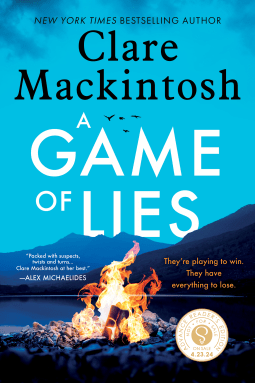
Last April I was lucky enough to hear Clare Mackintosh speak about her foray into a mystery series. It was a change from writing her suspenseful standalones.
After writing the first book, The Last Party, Mackintosh felt that she was not ready to say good-bye to Ffion and those in her world. I am so glad that she did not. I enjoyed The Last Party and highly recommend it. I also very much enjoyed A Game of Lies.
Would you want to be on reality TV? Game of LIes is predicated on a group with secrets who sign up for what they think is one show only to find out (when it is too late) that the show’s premise is based on something else entirely. This leads to disappearance, murder, and a need to find those responsible.
Mackintosh does a good job of evoking the book’s setting on the border of Wales and England. I welcomed back all of the ongoing characters and their (sometimes tricky) relationships. Prickly Ffion is a great character. That she has heart is clear from her relationship with Dave. (Read the book to learn who this is.) I also was happy to again meet up with Leo.
It is not necessary to have read The Last Party to enjoy Game of Lies. That said, this is where the characters are introduced and their complex relationships explored. I recommend reading both. They offer what mystery/suspense readers are looking for.
Many thanks to Sourcebooks Landmark and NetGalley for this title. All opinions are my own.
Christian Dior is having a moment. He has featured in a recent Apple TV series as well as in a number of works of historical fiction. That is the case in this novel where window shopping and a dress by the couturier feature in the story.
Wells tells the story of three friends who reunite in post war Paris. They are Claire, Gina and Margot. Claire is a native French woman and chef. Gina is an American aspiring writer/journalist. Australian Margot is working at Dior’s fashion house. All have their struggles, relationships and hopes.
Early in the novel, readers learn that Claire was lucky enough to be loaned an apartment above her father’s bistro. The mysterious Madam Vaughan has gone away for reasons not initially shared and left Claire to occupy her home. She has also gifted a Dior gown to Claire. The three young women clearly benefit from her generosity.
Claire invites her friends to stay with her. Readers then follow them through their lives and will, I think, care about what happens to them.
This story is involving and nicely details the characters and their world. This is a story of female friendship that I very much enjoyed.
Many thanks to NetGalley and William Morrow for this title. All opinions are my own.
Jennifer Ryan has become one of my favorite writers of historical fiction and here she has written another successful WWII set story. In The Underground Library, she follows three main and many auxiliary characters.
Juliet has gotten her dream job, even if it may only be because the men are away. She is now the Deputy Librarian of the Bethnal Green Library. (Look it up for some great photos). She hopes to liven up the rather staid premises with a book club, children’s story hour and more. What will she contribute to the project that is the title of this book?
Juliet lives with a landlady and it turns out that she knows the other boarder. Juliet used to have no respect for him. Will her feelings change?
Katie has been working in the library while waiting to attend university. She becomes a friend and colleague to Juliet. However, Katie faces a serious crisis. Will she be okay?
Sophie lived a nice upper middle class life in Germany before the war. She has become a Jewish refugee in London. Sophie works for an incredibly mean spirited man and some in London view her in a rather prejudiced manner. She finds solace in the library. Will Sophie get a chance at something better? Will she ever be reunited with her family?
Readers also get to know a number of the library’s patrons. These include two older sisters and the rather bold Marigold. All of them interact over the course of the story including, of course, the three main characters.
The author does a good job of depicting wartime London. The descriptions of bombing raids, Anderson shelters and running to the underground for safety are all well portrayed.
This is a novel that will be enjoyed by those who like books about books, women’s fiction and WWII set stories. The pages definitely turn.
Look for all of Jennifer Ryan’s novels starting with The Chilbury Ladies’ Choir. They offer engaging reads.
Many thanks to NetGalley and Random House Publishing Group for this title. All opinions are my own.
Those who have read other novels by Susan Mallery will welcome this story about a group of women and their complex lives. Those who have not read the author’s books before may want to pick this one up when they are looking for an escapist read.
The main characters are Paris, Laurel and Cassie. Each has faced challenges in life and all are trying to figure out their next steps. Paris runs a farm stand that readers will wish that they could visit as it is both adorable and stocks quality products. In the past, Paris had been abused and her own temper led to the end of her marriage. Now her ex is back in town…
Laurel’s husband left her and the school says that her older daughter constantly puts men down. They ask Laurel to fix this, a big ask as where is a good man? Laurel runs her own business as well selling on goods from estate sales and other sources.
Cassie is living in Maine when the reader first meets her. However, her family wants her to start thinking of herself and they push her to go to California to see an inheritance.
As readers no doubt expect, these three women will get to know one another well. Readers will hope that they each find their way. As they try, the summer book club will be there for them and for the reader who may find some other suggested titles to be ones that they want to explore.
This book will appeal to readers of women’s fiction.
Many thanks to NetGalley and Harlequin Trade Publishing for this title. All opinions are my own.
Robyn Carr knows how to write the kinds of stories that her readers love. From series like Virgin River to her many standalones, the pages turn with Ms. Carr. Learn about her newest novel below.
Many thanks to the team at HTP for my stop on this blog tour.
THE FRIENDSHIP CLUB
Author: Robyn Carr
ISBN: 9780778311881 Publication Date: January 23rd, 2024
Publisher: MIRA 28.99 US | 35.99 CAN
Book Summary:
Four women who work on a popular cooking show band together when they discover the youngest member of their group has an abusive boyfriend. The Barefoot Contessa meets Big Little Lies in this drama-filled novel about the power of female friendships.
Marni McGuire is the host of a popular television cooking show and leads a very happy life. Twice married, she has been widowed and divorced and now, in her mid-fifties, she enjoys being a successful single woman. But Marni’s daughter Bella, who is pregnant with her first child, is convinced that Marni is lonely and she is determined to find a new man for her mother. To humor her daughter, Marni goes on a series of terrible dates. Marni’s best-friend and colleague from the cooking show, Ellen, is a widow who has no interest in meeting anyone new and the two women have discussed the challenges of marriage and the joys of being single. But, while Ellen is adamant she wants nothing to do with men, Marni has to admit to herself that she would like to be with someone but only if he is the right fit.
As Bella’s pregnancy progresses she admits to her mother that she has some concerns about the state of her own marriage, and all three women are concerned that the young intern on the cooking show is caught in a toxic relationship.
Marni and Ellen are determined to guide the two younger women to have the strength, confidence and support to improve their situations and the women gather regularly to talk about the important issues in their lives.
When Marni and Ellen each unexpectedly find themselves falling for new men in their lives the younger women help them navigate the dating world.
Together these four women form a strong bond of family and friendship that will anchor all of them as they navigate the challenges and celebrate the joys of life.
Start reading:
ONE
“And that’s a wrap,” the director said. “I think I have everything I need. I’ll do some editing and you can review it.”
“Thanks, Kevin,” Marni said. “My sister and my daughter are coming by for a glass of wine. Would you like to join us for a drink to celebrate finishing another season?”
“Thanks, no. I’m on the timer. New baby on the way,” he said.
“Of course! How’s Sonja feeling?”
“Huge,” he said with a laugh. “But the baby’s still cooking. The midwife says she has a few more weeks. Sonja cried for an hour after hearing that.”
“I remember that feeling,” Marni said. “Like it was yesterday. You better stay close to her. Thanks for everything this season. I think we got some good stuff.” Then Marni turned to her intern, Sophia Garner. “But you’ll stay, right?”
“I wouldn’t miss it,” she said. “It’s going to be an intervention, I think.”
“Oh, fabulous, I love those,” Marni said with a hint of panic. “If you and Ellen clean up, I’ll put out some hors d’oeuvres.”
Of course she was prepared; just a little fixing up and presentation required. Marni Jean McGuire worked every day and took very few breaks from cooking, writing, studying, traveling and experimenting with new recipes but they only filmed the segments of her show sixty days a year. But filming was intense. Twice a year they’d film for thirty days over six weeks—enough for two seasons. She hosted one of the most popular cooking shows on a cable network. Today marked the last day of filming and they always celebrated.
Marni’s kitchen was essentially a set; all their filming was done in her home as opposed to a studio. She smiled as she watched her producer, Ellen, who was busy cleaning up with Sophia. Ellen was a bona fide chef but she had no interest being in front of the camera. Sophia loved the camera and the camera loved her; after being caught on camera accidentally a few times, she had become beloved by the viewers for her quick wit and delicious accent.
Marni Cooks was very popular but hosting a TV show had never been her lifelong goal. Far from it. It fell into her lap like a glorious miracle. When she was a young widowed mother, she did whatever she could to make a dollar and raise her little Bella. She took a job handing out food samples for a chain of grocery stores. With her baby in a carrier on her back, she turned out to be a hit. She sold out her product day after day, probably because Bella was so funny and flirtatious and Marni, despite the fact that life hadn’t been easy, was personable and approachable. Almost immediately after she began, shoppers came looking for her, engaging her in conversation. They gave her good reviews and told store managers how much they liked her.
Once she filled in for a product demonstrator for the same grocery chain, showing interested patrons how to slice, dice, shred, spiral and chop vegetables. Again, Bella rode along; childcare was impossibly expensive. Her sense of humor and ease with being in front of a small audience charmed people—including the producer from a television station. Marni was hired to demonstrate a couple recipes every week on a local morning show. Along with that she did cooking demonstrations at fairs or exhibits, published a couple of small cookbooks, helped out at catering services, began writing a short cooking column for the newspaper and filled in when other chefs were unavailable as a guest on various cooking shows. Then she landed a full-time job as the on-air chef for a cable cooking show. She had been thirty-two. Her viewing audience grew quickly and soon after she hired Ellen, who was an expert in her own right. Marni was syndicated to a handful of affiliates and her popularity continued to grow. She knew she owed as much of her success to Ellen as to her own hard work. Ellen had a knack for delectable creation but she was such an introvert she would never agree to join Marni in front of the camera.
But in Ellen’s hands the food became a living, breathing wonder and she had become the associate producer over time, thanks to Marni. She knew what a gift she had in Ellen and took very good care of her. And Ellen knew what a great opportunity she had with Marni; no one else in the business would let her just cook without taking on any management responsibilities and yet pay her so well. But every time Marni’s fortunes improved, Ellen benefited as well.
A little over twenty years ago Marni had met Jeff, a news anchor for the local affiliate. Since she lost her young husband when Bella was only nine months old, she hadn’t been optimistic she’d ever find another forever man but fate shocked her by delivering up Jeff. It was a great love, filled with promise and passion. They were a team from the start, both of them being in TV and very visible in the community. They worked together, shoring each other up and urging each other on. Jeff was a fantastic stepfather for Bella and proudly walked her down the aisle six years ago.
Shortly after that something changed. Marni was concerned that a woman Jeff worked with had ulterior motives. She’d been stalking him for years, texting him, asking his advice, professing to be his friend and protégé and constant supporter. Marni had warned Jeff many times that he needed to be careful not to encourage this woman and he always said he could handle things. But his behavior changed and Marni grew suspicious. She caught them making out in Jeff’s car in the parking lot of a local park that sat in the shadow of the beautiful Sierras.
When she realized what she was witnessing, she drove very slowly up close to Jeff’s car and laid on the horn. They jumped apart like two heart attacks. It was divine.
She knew in that moment that her marriage, which she had enjoyed a great deal, was over. Clearly Jeff had been lying and leading a double life for years. The pain of that was excruciating. She also instinctively knew that Jeff and the woman had both gotten what they deserved—each other. Neither was honest nor faithful. In an instant she knew, she would not go a second further with a man who could look her in the eye and deceive her. She told him to leave. He didn’t argue or try to save their marriage, but he did hire a good lawyer and fought for a healthy settlement. At that time they both had solid careers, but Marni was edging ahead. Jeff went after a big slice of that success; indeed, he took credit, as he’d given her so much wonderful advice. At least that was his perspective.
At Marni’s insistence, they settled and divorced quickly. Marni had asked herself if she should pause and think it over, maybe try marriage counseling, but a gut instinct said end it fast. When he asked for a percentage of her future earnings, she knew she’d been right. It had to be over as swiftly as possible. She gave him half, though he hadn’t earned half. Since there were no minor children or businesses involved, he couldn’t possibly do better. She cut him a big check, waved goodbye and ran for her life. She learned you can still sprint pretty well with a broken heart.
After a couple of years of hating him, things settled down. Marni had handed over more money than seemed fair to her, certainly more than Jeff deserved, and that angered her but the relationship was over in her heart. And Karma being a vicious soul, Jeff was demoted in his job while Marni’s popularity soared.
Jeff had used his settlement to open a restaurant, hoping to capitalize on Marni’s notoriety as a television chef. But Gretchen, the other woman, was his business partner and Marni refused to endorse the restaurant. While he was busy trying to cash in on her success, Marni just put her head down, worked hard and became even more popular.
Then there was a sea change. Jeff had not married Gretchen, but he had spent a lot of money on her, found her cheating, and she unceremoniously dumped him, leaving Jeff a broken, much poorer man…with a struggling restaurant. Of course he brought his tons of regret to Marni, begging her forgiveness. Telling her that letting her go was the biggest mistake of his life!
“No doubt about it,” Ellen had said.
“Too little, too late,” Bella said. Bella was, if possible, angrier than Marni about Jeff’s betrayal.
“Men are so stupid,” said Sophia when she heard the story.
Marni had long since stopped complaining to her friends. To Jeff she said, “You broke my heart and tore my family to pieces. Don’t expect any sympathy from me.”
“You don’t understand, Marni,” he said. “I think she used me and turned me against you, the only woman who truly loved me.”
“Oh, I believe I understand completely,” she had said. The story was as old as time. He’d succumbed to flattery and been thinking with his dick. No amount of his regret would change the fact that she’d be an idiot to ever trust him again. She was no idiot.
But she did soften her anger slightly and they were now cordial. Every now and then Jeff would call her or text her or stop by, though the locks on the house had long since been changed. Over the past couple of years he had suggested a few times that they go out for dinner and she always declined. He clumsily proposed she might cook something for him. “One of your favorite new recipes… I would love that.”
“Not in your wildest dreams,” she had replied.
Marni heard the dishwasher start and snapped out of her thoughts of the past. She pulled her pesto canapés from the oven, the artichoke dip from the refrigerator and heard Kevin depart.
The door opened again. “Mama?” Bella called.
“Right in here,” Marni said. “How is the bump?” Bella was five months pregnant and cute as a button. It was a pregnancy hard won through wildly expensive in vitro fertilization.
“A little feisty,” she said with a very proud smile.
The door opened again and Marni’s sister, Nettie, came in from the garage.
Marni put down her hors d’oeuvres and transferred the centerpiece from the kitchen island to the long rectangular coffee table in the great room just as Ellen was bringing in a tray of wineglasses. Sophia followed with a large oval-shaped bucket filled with ice and two opened bottles of white wine. She went back for a chilled bottle of sparkling cider in an ice bucket on a tripod stand for Bella since she was off alcohol.
Marni loved watching them enter the room, her colleagues and loved ones. Ellen came into a room with shy demeanor, standing nearly six feet tall, lithe and graceful. She wore her her once blond and now white-gray hair in a simple pageboy. She always bent her head slightly and Marni wasn’t sure if her height made her uncomfortable or if it was her shy nature.
Nettie, ten years younger than Marni and the mother of two sons, was an English professor at the university in Reno.
Marni brought out a couple more plates of hors d’oeuvres, Sophia placed napkins all around, Ellen pushed over an ottoman for Bella to rest her feet upon, and they settled in. First was a toast. “A very good season, I think,” Marni said. “One of our best. I’m sleeping in tomorrow.”
Glasses were clinked in agreement, small plates were filled, napkins unfolded. And Marni looked around with a feeling of warm satisfaction. This was her happy place. This great room with her closest friends and family. And outside, through the patio doors, reflected in the backyard infinity pool was the sight of the Sierra Nevada mountains, still covered with snow, though it was May. They all lived in Breckenridge, Nevada, a picturesque little town nestled into the base of the mountain range just south of Reno and Lake Tahoe. There was a winding road, not exactly a secret but little known, that went switchback up over the mountains and then down into Lake Tahoe. People who grew up in Breckenridge knew it well.
This was an agricultural and ski town, with the mountains so close, and it was beautiful with its million-dollar views of nature at her best. To Marni, it looked similar to Austria.
Marni had overseen every aspect of the construction of this house, the kitchen being the focal point. She and Jeff were married at the time and while he helped by sharing advice and supervising construction, it was her house. She approved the plans and made it part of her business. And she loved it. Knowing it would be caught on camera, it was beautifully decorated in beiges, browns, pinks and mauves. It was redecorated almost annually for the same reason—updating for the viewers. But the most important thing to Marni was that the house felt like a hug to her, making her feel safe and protected.
When Jeff moved out, she filled the empty space he left in no time at all. Filling the empty space in her heart had taken longer. Even though she had stopped loving him and stopped hating him, there was still a hole there. A black cold hole. It frequently reminded her that she had no talent for love.
Robyn Carr is an award-winning, #1 New York Times bestselling author of more than sixty novels, including highly praised women’s fiction such as Four Friends and The View From Alameda Island and the critically acclaimed Virgin River, Thunder Point and Sullivan’s Crossing series. Virgin River is now a Netflix Original series. Robyn lives in Las Vegas, Nevada. Visit her website at http://www.RobynCarr.com.
I am very excited to be a part of this blog tour. I have enjoyed everything that I have read by this author. Fans of historical fiction will too. This book is definitely worth a look!
Many thanks to everyone at HTP for this opportunity.
About the Book:
A heartwarming story about a mother and daughter in wartime England and the power of books that bring them together, by the bestselling author of The Last Bookshop in London.
In Nottingham, England, widow Emma Taylor finds herself in desperate need of a job. She and her beloved daughter Olivia have always managed just fine on their own, but with the legal restrictions prohibiting widows with children from most employment opportunities, she’s left with only one option: persuading the manageress at Boots’ Booklover’s Library to take a chance on her with a job.
When the threat of war in England becomes a reality, Olivia must be evacuated to the countryside. In the wake of being separated from her daughter, Emma seeks solace in the unlikely friendships she forms with her neighbors and coworkers, and a renewed sense of purpose through the recommendations she provides to the library’s quirky regulars. But the job doesn’t come without its difficulties. Books are mysteriously misshelved and disappearing and the work at the lending library forces her to confront the memories of her late father and the bookstore they once owned together before a terrible accident.
As the Blitz intensifies in Nottingham and Emma fights to reunite with her daughter, she must learn to depend on her community and the power of literature more than ever to find hope in the darkest of times.
Start reading:
PROLOGUE
Nottingham, England April 1931
JUST ONE MORE CHAPTER. Emma lingered in the storage area on the second floor of her father’s bookshop, Tower Bookshop, with Jane Austen’s Emma cradled in her lap. Sadly, not her namesake—her parents had named her Emmaline for an aunt she’d never met, who had died on Emma’s seventh birthday ten years ago.
Still, the book was one of Emma’s favorites.
“Emma.” Papa’s voice rose from somewhere in the bookshop, sharp with irritation.
She frowned. Papa was seldom ever cross with her.
Perhaps the smoke from the man who had come in with his cigar earlier still lingered in the shop.
She settled a scrap of paper into the spine of her book.
“Emmaline!” Something to that second cry snapped her to attention, a raw, frantic pitch.
Papa was never panicked.
She leaped up from the seat with such haste, the book dropped to the ground with a whump.
“I’m in the warehouse,” she called out, racing to the door.
The handle was scalding hot. She yelped and drew back. That’s when she saw the smoke, wisps seeping beneath the door, glowing in the stream of sunlight.
Fire.
She put her skirt over her hand and twisted the knob to open the door. Thick plumes of smoke billowed in, black and choking.
She sucked in a breath of surprise, unintentionally inhaling a lungful of burning air. A cough racked her and she stumbled back, her mind reeling as her feet pulled her from the threat.
But to where? This was the only exit from the storeroom, save the second-floor window.
“Papa,” she shouted, terror creeping into her voice.
All at once, he was there, wrapping a blanket around them, the one she kept in the shop for cold mornings before the furnace managed to heat the old building.
“Stay at my side.” Papa’s voice was gravelly beneath the blanket where he’d covered the lower part of his face. Even as he led her away, a great cough shuddered through his lean frame.
Beyond the wall of smoke was a vision straight out of Milton’s Paradise Lost as fire licked and climbed its way up the towering stacks of books, devouring a lifetime of careful curation. Emma screamed, the sound muted by the blanket.
But Papa’s hand was firm at her back, pressing her forward. “We have to run.” Not slowing, he guided her to the winding metal staircase. She used to love clattering down it as a girl, hearing the metal ringing around her.
“It’s hot,” Papa cautioned. “Don’t touch it.”
Emma hugged against his side as they squeezed down the narrow steps that barely fit the two of them together. It swayed beneath their weight, no longer sturdy as it had once been. The blazing heat felt as though it was blistering Emma’s skin. Too hot. Too close. Too much.
And they were plunging deeper into the fiery depths.
The soles of Emma’s shoes stuck to the last two steps as rubber melted against metal.
What had once been rows of bookshelves was now a maze of flames. Even Papa hesitated before the seemingly impassable blaze.
But there was nowhere else to go.
The fire was alive. Cracking and popping and hissing and roaring, roaring, roaring so loud, it seemed like an actual beast.
“Go,” he shouted, and his grip tightened around her, pulling her forward.
Together they ran, between columns of fire that had once been shelves of books. An ear-shattering crack came from above, spurring them to the front as fire and sparks poured down behind them.
Emma ran faster than she ever had before, faster than she knew herself capable. Papa’s arm at her side yanked her this way or that, navigating through the fiery chaos. Until there was nowhere to go.
Papa roared louder than the fire beast and released her, running toward the blazing door. It flew open at the impact, revealing clean sunny daylight outside. He turned toward her even as she rushed after him and grabbed her around the shoulders, hauling her into the street.
Emma gulped in the clean air, reveling in the cool dampness washing into her tortured lungs. A crowd had gathered, staring up at the Tower Bookshop. Some came to Emma and Papa, asking in a frenzy of voices if they were hurt.
In the distance came the scream of emergency sirens. Sirens Emma had heard her entire life, but had never once needed herself.
There was need now. She held on to Papa’s hand and looked behind her at the building that had been in her family for two generations and was meant to become hers someday. Her gaze skimmed over the bookshop to the top two floors where their home had once been.
The fire beast gave a great heaving howl and the top floor crumpled.
Someone grabbed her from behind, dragging her back as the rest of the structure came down, ripping her hand from her father’s. She didn’t reach for him again, unable to move, unable to think, her eyes fixed on the building as it crashed in on itself in a fiery heap. Their livelihood. Their home.
All the pictures of her mother who had died after Emma was born, all the books she and her father had lovingly selected from bookshops around England on the trips they’d taken together, everything they’d ever owned.
Gone.
Emma choked on a sob at the realization.
Everything was gone.
“We need a doctor.” A man’s voice broke through her horror, pulling her attention to her father.
He lay on the ground, motionless. Soot streaked his handsome slender face, and his thick gray hair that had once been the same shade of chestnut as hers was now singed in blackened tufts.
“Papa?” She sagged to the ground beside him.
His eyes lifted to her, watery blue and filled with a love that made her heart swell. The breath wheezed from his chest like a kettle’s cry. “You’re safe.”
Once the words left his mouth, his body relaxed, going slack.
“Papa?” Emma cried.
This time his eyes did not meet hers. They looked through her. Sightless and empty.
She shuddered at how unnatural he appeared. Like her father, and yet not like her father.
“Papa?”
The wailing sirens were still too far-off.
“I’m a doctor.” A man knelt on the other side of her father. His fingers went to Papa’s blackened neck and the man’s sad brown eyes turned up to her.
“I’m sorry, love. He’s gone.”
Emma stared at the man, refusing to believe her ears even as she saw the truth.
It had always just been Emma and her father, the two of them against the world, as Papa used to say. They read the same books to discuss together, they worked every day at the bookshop together, friends and colleagues as much as they were father and daughter. Once Emma had completed her schooling, she’d even traveled with him, curating books like the first editions they were still waiting on to arrive from Newcastle.
Now that beautiful light that shone in his eyes had dulled. Lifeless.
Madeline Martin is a New York Times, USA Today, and internationally bestselling author of historical fiction and historical romance with books that have been translated into over twenty-five different languages.













 Joyce's mystery and fiction book reviews with some non-fiction too!