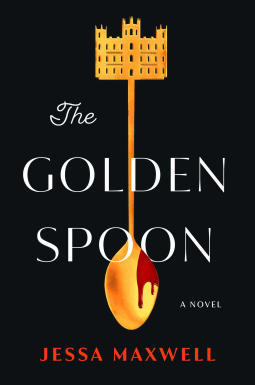
Perfect for curling up with on a winter’s evening, this book engaged me right from the start. Six bakers arrive at a Vermont estate to compete on a baking show that fans of the Great British Baking Show will recognize right away. However, what if unlike on the GBBS, all did not go well and the issues were not only with the bakes? What if, Instead, murder and mayhem occur during the competition? The bakers are a captive audience so there are also echoes of Agatha Christie, along with Mary Berry, in these pages.
The bakers all have their stories and get to tell them as each narrates sections of the book. They range from a former foster child to a retired nurse, from a self made millionaire to a math teacher, along with a young pie maker and a construction worker. There are other characters as well. These include baking show host and owner of Grafton Manor, Betsy Grafton, the new co-host, Archie, the conniving Melanie and others. How do these characters backstories impact their actions? Who will be murdered and why? Find out, even as you enjoy the baking challenges.
Simon & Schuster’s Editorial Director describes The Golden Spoon as “this wonderfully atmospheric debut” that is “one of the most satisfying puzzles I have read in ages.” I concur. This novel is written by an assured writer who tells an involving story. I highly recommend this one.
Many thanks to NetGalley and Simon & Schuster for this title. All opinions are my own.
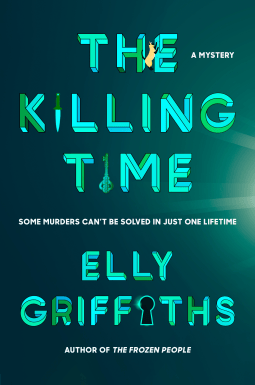
Elly Griffiths is one of my favorite authors. Her book are always a must read for me.
The Killing Time is the second title in Griffith’s newest series, following on The Frozen People. While this book could be read as a standalone, readers will most enjoy it if they have had the joy of reading The Frozen People.
The novels in this series do require suspension of disbelief. However, I am always willing to follow wherever Griffiths wants to take me.
These novels combine a traditional crime story and time travel. In this title and in the first book, most of that travel is to Victorian England. In the first book, Ali experiences the life of someone without money, while in the second, she is having a far more luxurious time with Lady Serafina, aka Jones, who is a character in both stories. Readers also revisit a number of the people that Ali met on her first time bending adventure. Readers may especially remember Cain.
In the present Ali and some of her colleagues attend a show with a mind reader named Barry. They are skeptics for sure. Barry is being investigated because Ali was asked by a mother to look into her son’s suicide. This son’s death is not the only one in these pages and one of the murders strikes quite close to home.
I was delighted to again spend time with the characters in the present as well. These include Ali’s son, Finn, and all of her colleagues. One of these coworkers, Dina, has a budding romance with a detective in the story.
Be sure to look at the cover of this novel. You will see some images that are relevant to the story there.
I highly recommend this title. I am eager for the third in the series which will come out in England in February 2027. I look forward to it being issued here in the U.S. as well.
Many thanks to NetGalley and Viking Penguin for this title. All thoughts are my own.
Pub date: 17 November 2026
320 pages
Mystery
Five stars 🌟🌟🌟🌟🌟
Post first published on 26 October 2026
Description:
from the publisher
The second mystery following Ali Dawson, the brilliant time-traveling detective, on her newest foray into Victorian London
Detective Ali Dawson leads a unit that investigates cases so cold her team must travel back in time to solve them. But ever since their technical expert, Jones, got stuck in Victorian London, Ali and her team have been forbidden from time travel.
At a loss, Ali dives into a present-day case – an apparent suicide of a young man who fell to his death from a high building. Ali believes the death is linked to a bad-news psychic medium, Barry Power, who convinced the boy he could fly. Suspicious, Ali attends one of Power’s shows, where he claims to be in contact with none other than Jones.
Minor trouble closer to home inspires Ali to sneak back in time just long enough to prevent misfortune. Her plan backfires, and she finds herself once again in Victorian London, where she reencounters Jones, as well as the darkly mysterious Cain Templeton, with whom Ali has unfinished business from her previous visit to the nineteenth century . . .
When she spies Barry Power lurking in the past, Ali knows she’s onto something. But with a potential murderer operating in multiple centuries, how on earth is she supposed to protect everyone at risk?
It’s a different time. It’s a dangerous time. It’s the killing time.
From the Publisher:
Editorial Reviews
Review
Advance praise for The Killing Time
“Warm and engaging characters and a wildly brilliant story wittily told; I loved this book.” —Ann Cleeves, New York Times bestselling author of the Vera Stanhope and Jimmy Perez series
“Here’s a paradox: a thriller that is full of zest and joy.” —Nicci French, international bestselling author of The Last Days of Kira Mullan
“[An] entertaining sequel to The Frozen People . . . Delicious subplots . . . brisk pacing, cleverly managed time travel, and fascinating bits of historical detail win the day. Fans of the first novel will be delighted by this one. ” —Publishers Weekly
Fiona Davis has written a number of historical fiction titles. Each book is set in an iconic NYC landmark and has a dual narrative structure and timeline. In this, the strongest of her novels yet, the reader spends time at the main New York Public Library on Fifth Avenue.
The story in the past begins around 1913. The iconic library has just opened. The superintendent, Jack; his wife, Laura; and their two children, Pearl and Harry actually live in an apartment inside the enormous new library. Jack, in addition to his job, is writing what he hopes will be the great American novel. Laura, up until now, a woman who married for love and cares for her family wants more. She enrolls as one of very few women at the Columbia School of Journalism. Jack and Laura’s desire for fulfillment leads to conflict, misunderstandings and tragedy. The fallout from their actions influences the story that takes place in the 1990s which is about their descendants.
In the present, Sadie works as a curator at the very same library on 42nd Street. Her love of all things bookish is apparent. Under Sadie’s watch, volumes are being stolen from the library. How do the past and present collide? Read the book to find out.
I learned a lot about collectable and antiquarian books as well as the library through reading this novel. I now know more about valuable books and how they are both vulnerable and protected. Clearly Ms. Davis has been meticulous in her research and loves her subject.
There are themes to this novel in addition to the mystery, romance and depictions of life at the Columbia School of Journalism, the Village and the library. What sacrifices are women asked to make and when are they too much? How much is owed to a family? Can we be forgiven for mistakes? How important is it to have a relationship and to take risks for it? Who should define what a person wants in life?
Ms. Davis does an excellent job of connecting the two narratives. The book is a page turner that will be eagerly embraced by her loyal readers and will also be enjoyed by those new to the author.
Many thanks to NetGalley and the publisher for this title in exchange for an honest review. I recommend it very highly.
Becoming Mrs. Lewis by Patti Callhan tells the story of Joy Davidman and C.S. (Jack) Lewis. I absolutely adored that book so was thrilled when I received an early review copy of Once Upon a Wardrobe, another novel about C.S. Lewis.
The structure of the story is that George, a young boy with a heart defect, discovers The Lion, The Witch and The Wardrobe and wants to know more about it. George’s sister, who loves him deeply, shares that Lewis is at Oxford where she, Megs, is a student. Wanting to do what she can for George, Megs gets to know Jack and Warnie and brings the tales that Lewis shares home to her brother.
Jack’s life story is beautifully told. There were very hard times and yet a man emerged who is so beloved by many. I won’t detail the biography so that readers can discover it for themselves.
George is preternaturally wise about life while Megs is perhaps less so. Over the course of the novel, she learns that her beloved scientific point of view and way of solving problems is but one way to look at the world. She and George are both deeply human, seeking, loving people with whom readers will enjoy spending time.
Those who have read the Narnia stories will eagerly read this title looking for the same insights that young George is seeking…to understand where the characters in the books came from, who they may have been based on and more. Will those answers be in these pages? You will need to read the novel to find out.
Those who have not read the Narnia books can still love this title. Its insight into a person’s life with all of its tragedies and peaceful moments are for all readers.
I give this one my highest recommendation. Ms. Callahan your talent for understanding Lewis and life are so impressive.
Many thanks to NetGalley and the publisher. All opinions are my own.
Val McDermid is one of my favorite crime writers. She is a pioneer in the crime fiction world, beginning with her Lindsay Gordon series. Lindsay was the first lesbian to feature in a mystery as protagonist. By the way, these titles have been reissued along with the author’s Kate Brannigan novels. And, of course, Ms. McDermid’s fans also follow Tony Hill and Carole Jordan as well as Karen Pirie in the novels featuring them.
Not one to rest on her laurels, now there is this series. It follows Allie Burns. Allie is a reporter on a Scottish daily at a time when women in the newsroom were few and rarely reported on anything other than women’s issues. Allie, though, is becoming a tough investigative reporter.
Two of the stories that Allie follows are the one with financial chicanery and tax evasion at its core, and a second that involves Scottish Nationalists who want to plan an IRA like bombing. Allie investigates both of these stories with fellow reporter Danny.
In my opinion this book starts a bit slowly but things speed up to be sure. What follows is a suspenseful and involving story with well sketched characters, settings and situations. McDermid started her career (after an Oxbridge education) at a local paper. She, presumably, uses this knowledge in creating Allie and the newsroom.
Fans of McDermid will be eager to read this title. I enjoyed it and I look forward to additional titles in this new series.
Many thanks to NetGalley and the publisher for this title. I was very excited to read it. All opinions are my own.
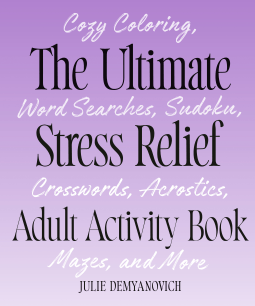
I am a person who enjoys puzzle books. I like time away from devices with a diverting activity that mildly stresses my brain. So, I was interested to take a look at this title.
There are a number of different types of puzzles in these pages including Crosswords, Logic Grid Puzzles, Acrostics, Sudoku, Magic Square, Number Search, Kakuro, Wordsearch, Coloring, Mazes, Cryptograms and more. There are solving directions for r those who are unfamiliar with some of the puzzle types.
The puzzles are in themed chapters. A few of those titles include Cozy Corners, Wanderlust and Whimsical Wonders.
At 192 pages, this title should offer hours of solving enjoyment. Time to get the pencils out!
Many thanks to NetGalley and Zeitgeist for this title. All thoughts are my own.
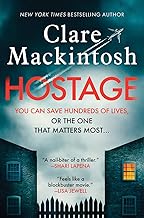
Are you a person who finds getting on an airplane to be an adventure or are you a nervous flyer? Either personality type may well be riveted by this thriller in which much of the action centers on a long haul flight from London to Sydney (20 hours in the air!). In some ways, the story is a take on a locked room mystery in that much of the action is confined to the plane and the stories of its passengers and crew. However, there is also backstory so some time is spent on the ground and with other characters.
The book’s protagonist, Mina, is on the flight when…a note is given to her. What does it say? How will it influence what she does? In order for there not to be spoilers, it is not possible to say more except that this is a story that may well put readers on the edges of their seats.
My only quibble with this story is that I did not absolutely love some of the characters and I don’t just mean the “bad” ones.. I do, though, admire Ms. Mackinstosh’s imagination and storytelling ability. Readers, remember that this is fiction!
Many thanks to NetGalley and the publisher for this title. All opinions are my own.
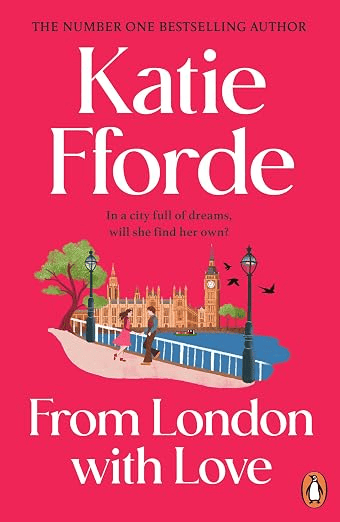
Do you ever need a book that offers feel good escape of the highest order? Will it matter if, at times, it seems more like a fairy tale than real life? Would you like a book with very appealing characters, a 60s set London, mudlarking, books, all kinds of relationships (mother-daughter; mother-stepmum; romantic; friendship)? If yes, this is the perfect book to pick up. I found it so easy and enjoyable to read, a true antidote to all that is going on in the world.
Highly recommended to fans of Katie Fforde and hopefully some new fans as well.
From the publisher:
A beautiful Chelsea town house. A chance to fulfil her dreams. A life adventure awaits…
”The queen of uplifting, feel good romance.” AJ Pearce ”A force to be reckoned with for her uplifting tales of romance” Daily Express ”Top-drawer romantic escapism.” Daily Mail ”Warm, brilliant and full of love.” Heat ”Warm, wise, witty and with a wonderful retro flavour, From London With Love is a trip to the city you won’t want to miss!” Lancashire Telegraph __________
It’s 1968 and it’s cold when Felicity arrives in London to stay with her mother, improve her English, do a secretarial course – and meet a suitable man.
She is already missing her home in Provence and her father and his new wife and their extended family. But it’s only for a year she tells herself – and then she can go back to France and do what she really wants and become a painter.
And then she bumps into Oliver who is quite the most interesting young man she has ever met. He lives on a barge for one thing and has a collection of jobs, but his passion is looking for hidden treasures along the shores of the river Thames.
In a word, he’s a mudlarker – and before long Felicity is mudlarking too. She is also pursuing her dreams and painting scenery for Oliver’s actor friends.
But is Oliver a Suitable Man of whom her mother will approve? Felicity knows she will not …
Love, tangled relationships, and a real life adventure lie at the heart of Katie Fforde’s heart-warming new novel. __________
I will start by saying that I highly recommend this title which is a story of Germany in the aftermath of WWII. Set in several countries, including Britain, Germany, Italy and Switzerland, it is the story of the titular Edith Graham. As the novel opens, Miss Graham is an educator living at home with her mother, a life that she finds somewhat dull and meaningless. When she is offered the opportunity to go to Germany to help with the re-establishment of educational facilities, she is really for the change and challenge. But…much more is in store for Edith.
Readers learn that, before the war,Edith was in love with a handsome, smart, German man named Kurt. Miss Graham also became close to his wife Elisabeth. What happened to this couple during WWII? How did they survive? What did they do? What happened to them afterwards? Their story line forms a large part of the narrative.
Around Edith are various agents, each with their own, and sometimes overlapping, agendas. There are Dori, Vera and Adeline for the women, each of whom has been shaped by their wartime experiences. In addition, there are the men; they represent the U.S. and the British. What are their agendas? How will these intersect with those of the women?
There is espionage here and, after a slightly slow start, a book that had me turning the pages and connecting with the characters. In addition to an excellent plot, the book raises a number of issues: what was life like for the Germans as the Americans, Russians and British entered their defeated country? How do people survive when they have nothing, not even food? Do ends justify means? Who can be trusted? Can there be justice in a world that has been turned upside down?
As readers follow the story, each chapter begins with an entry from Miss Graham’s Cold War Cookbook. Readers will learn the significance of these menus as they become involved with the novel.
I have read many books of historical fiction about WWII. This one is a bit different in that it largely takes place after the war. It is a compelling read and one that I recommend most highly. I give it five stars, something I do not often do.
Many thanks to NetGalley and the publisher for this read in exchange for an honest review.
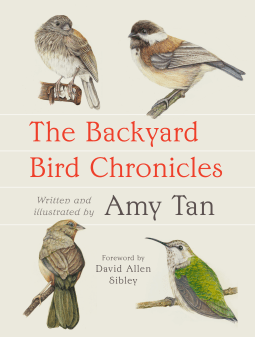
Many know Amy Tan because of her novels including the wonderful The Joy Luck Club. Here readers get to spend time with a Tan who wants to feel closer to the natural world. It is an incredible treat!
This title is in the form of a journal. I found it to have many insights and observations. To add to the gorgeousness of this title, the illustrations are by the author herself.
Those who already know Tan’s novels, as well as those who love birds and/or nature, and spending time with a wise woman, need to pick up this title
Highly recommended.
Many thanks to Knopf, Pantheon, Vintage and Anchor as well as NetGalley for this title. All opinions are my own.