The Old Success follows The Knowledge, a book that I really enjoyed. The Old Success is not quite as good but will still be welcomed by fans of Richard Jury and his eccentric circle of friends. Old readers, for example, will probably love Melrose’s latest attempt to get at his aunt. You do not have to have read all the books in the series to pick this up but it may help to know a bit about the cast. In this novel, there are three murders. One takes place in the Scilly Islands, one in Exeter Cathedral and one on a family estate. Are they linked, and if they are, what is the connection? As usual, there are characters who are children and essential to the story. In this case, the reader meets Zillah and Zoe. What did they witness? What is their connection to the bigger mystery surrounding the deaths? The title of the book comes from the name of a pub, as is usual for Martha Grimes. Those in the pubs are witnesses and friends, including a retired police officer who solved all his cases. There is also his granddaughter who is talented at working with horses. Quite a mix. Of course, all is solved. I read this book quickly. I rate it at 3 stars. Thanks to NetGalley and the publisher for this advance read in exchange for an honest review. The book publishes in November.
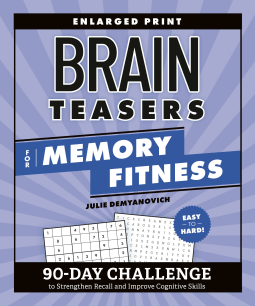
90-Day Challenge to Strengthen Recall and Improve Cognitive Skills
by Julie Demyanovich
#BrainTeasersforMemoryFitness #NetGalley
From the publisher:
Improve your memory—and have fun!—with 90 days of brain teasers.
Forgot where you put your keys multiple times this week? Having difficulty remembering your to-do list? Boost your ability to recall details and strengthen your long-term memory with Brain Teasers for Memory Fitness, the ultimate 90-day mental challenge that increases in difficulty from easy to hard. With a variety of fun brain teasers, including trivia, word games, recall tests, sudoku, logic puzzles, and more, you’ll be amazed by the improvement you see in how you process and recall information. Get started on your journey to better memory fitness today!
Brain games focused on memory. Developed by a puzzle expert, these brain games are specifically designed to exercise and strengthen your memory functions.
90 days of brain teasers, plus bonus puzzles. With puzzles that go from easy to hard, this challenge will help you develop a consistent mental exercise routine.
Variety of activities. Enjoy a mix of trivia, word puzzles, memory games, recall challenges, sudoku, mazes, crosswords, and logic puzzles.
The perfect gift for any age. Enlarged, clear print and quality paper make this an ideal gift for adults of all stages, including seniors.
Keep your good habit of daily brain exercise going with the other top-selling titles in the series: Sudoku for Brain Fitness, Crossword Puzzles for Brain Fitness, Logic Puzzles Book for Brain Fitness, and Word Search Puzzles for Brain Fitness.
My thoughts:
Whether you want to improve your memory or you just enjoy the challenges of puzzles, this title is worth a look. Graded from easy to hard, find the puzzles that you will most enjoy or do the challenge as it is intended by the author. Either way, there are fun activities in these pages.
I recommend reading the introduction. There is interesting information to be found there. Then start puzzling.
Many thanks to NetGalley and Zeitgist for this title. All opinions are my own.
I am very excited to be a part of this blog tour. I have enjoyed everything that I have read by this author. Fans of historical fiction will too. This book is definitely worth a look!
Many thanks to everyone at HTP for this opportunity.
About the Book:
A heartwarming story about a mother and daughter in wartime England and the power of books that bring them together, by the bestselling author of The Last Bookshop in London.
In Nottingham, England, widow Emma Taylor finds herself in desperate need of a job. She and her beloved daughter Olivia have always managed just fine on their own, but with the legal restrictions prohibiting widows with children from most employment opportunities, she’s left with only one option: persuading the manageress at Boots’ Booklover’s Library to take a chance on her with a job.
When the threat of war in England becomes a reality, Olivia must be evacuated to the countryside. In the wake of being separated from her daughter, Emma seeks solace in the unlikely friendships she forms with her neighbors and coworkers, and a renewed sense of purpose through the recommendations she provides to the library’s quirky regulars. But the job doesn’t come without its difficulties. Books are mysteriously misshelved and disappearing and the work at the lending library forces her to confront the memories of her late father and the bookstore they once owned together before a terrible accident.
As the Blitz intensifies in Nottingham and Emma fights to reunite with her daughter, she must learn to depend on her community and the power of literature more than ever to find hope in the darkest of times.
Start reading:
PROLOGUE
Nottingham, England April 1931
JUST ONE MORE CHAPTER. Emma lingered in the storage area on the second floor of her father’s bookshop, Tower Bookshop, with Jane Austen’s Emma cradled in her lap. Sadly, not her namesake—her parents had named her Emmaline for an aunt she’d never met, who had died on Emma’s seventh birthday ten years ago.
Still, the book was one of Emma’s favorites.
“Emma.” Papa’s voice rose from somewhere in the bookshop, sharp with irritation.
She frowned. Papa was seldom ever cross with her.
Perhaps the smoke from the man who had come in with his cigar earlier still lingered in the shop.
She settled a scrap of paper into the spine of her book.
“Emmaline!” Something to that second cry snapped her to attention, a raw, frantic pitch.
Papa was never panicked.
She leaped up from the seat with such haste, the book dropped to the ground with a whump.
“I’m in the warehouse,” she called out, racing to the door.
The handle was scalding hot. She yelped and drew back. That’s when she saw the smoke, wisps seeping beneath the door, glowing in the stream of sunlight.
Fire.
She put her skirt over her hand and twisted the knob to open the door. Thick plumes of smoke billowed in, black and choking.
She sucked in a breath of surprise, unintentionally inhaling a lungful of burning air. A cough racked her and she stumbled back, her mind reeling as her feet pulled her from the threat.
But to where? This was the only exit from the storeroom, save the second-floor window.
“Papa,” she shouted, terror creeping into her voice.
All at once, he was there, wrapping a blanket around them, the one she kept in the shop for cold mornings before the furnace managed to heat the old building.
“Stay at my side.” Papa’s voice was gravelly beneath the blanket where he’d covered the lower part of his face. Even as he led her away, a great cough shuddered through his lean frame.
Beyond the wall of smoke was a vision straight out of Milton’s Paradise Lost as fire licked and climbed its way up the towering stacks of books, devouring a lifetime of careful curation. Emma screamed, the sound muted by the blanket.
But Papa’s hand was firm at her back, pressing her forward. “We have to run.” Not slowing, he guided her to the winding metal staircase. She used to love clattering down it as a girl, hearing the metal ringing around her.
“It’s hot,” Papa cautioned. “Don’t touch it.”
Emma hugged against his side as they squeezed down the narrow steps that barely fit the two of them together. It swayed beneath their weight, no longer sturdy as it had once been. The blazing heat felt as though it was blistering Emma’s skin. Too hot. Too close. Too much.
And they were plunging deeper into the fiery depths.
The soles of Emma’s shoes stuck to the last two steps as rubber melted against metal.
What had once been rows of bookshelves was now a maze of flames. Even Papa hesitated before the seemingly impassable blaze.
But there was nowhere else to go.
The fire was alive. Cracking and popping and hissing and roaring, roaring, roaring so loud, it seemed like an actual beast.
“Go,” he shouted, and his grip tightened around her, pulling her forward.
Together they ran, between columns of fire that had once been shelves of books. An ear-shattering crack came from above, spurring them to the front as fire and sparks poured down behind them.
Emma ran faster than she ever had before, faster than she knew herself capable. Papa’s arm at her side yanked her this way or that, navigating through the fiery chaos. Until there was nowhere to go.
Papa roared louder than the fire beast and released her, running toward the blazing door. It flew open at the impact, revealing clean sunny daylight outside. He turned toward her even as she rushed after him and grabbed her around the shoulders, hauling her into the street.
Emma gulped in the clean air, reveling in the cool dampness washing into her tortured lungs. A crowd had gathered, staring up at the Tower Bookshop. Some came to Emma and Papa, asking in a frenzy of voices if they were hurt.
In the distance came the scream of emergency sirens. Sirens Emma had heard her entire life, but had never once needed herself.
There was need now. She held on to Papa’s hand and looked behind her at the building that had been in her family for two generations and was meant to become hers someday. Her gaze skimmed over the bookshop to the top two floors where their home had once been.
The fire beast gave a great heaving howl and the top floor crumpled.
Someone grabbed her from behind, dragging her back as the rest of the structure came down, ripping her hand from her father’s. She didn’t reach for him again, unable to move, unable to think, her eyes fixed on the building as it crashed in on itself in a fiery heap. Their livelihood. Their home.
All the pictures of her mother who had died after Emma was born, all the books she and her father had lovingly selected from bookshops around England on the trips they’d taken together, everything they’d ever owned.
Gone.
Emma choked on a sob at the realization.
Everything was gone.
“We need a doctor.” A man’s voice broke through her horror, pulling her attention to her father.
He lay on the ground, motionless. Soot streaked his handsome slender face, and his thick gray hair that had once been the same shade of chestnut as hers was now singed in blackened tufts.
“Papa?” She sagged to the ground beside him.
His eyes lifted to her, watery blue and filled with a love that made her heart swell. The breath wheezed from his chest like a kettle’s cry. “You’re safe.”
Once the words left his mouth, his body relaxed, going slack.
“Papa?” Emma cried.
This time his eyes did not meet hers. They looked through her. Sightless and empty.
She shuddered at how unnatural he appeared. Like her father, and yet not like her father.
“Papa?”
The wailing sirens were still too far-off.
“I’m a doctor.” A man knelt on the other side of her father. His fingers went to Papa’s blackened neck and the man’s sad brown eyes turned up to her.
“I’m sorry, love. He’s gone.”
Emma stared at the man, refusing to believe her ears even as she saw the truth.
It had always just been Emma and her father, the two of them against the world, as Papa used to say. They read the same books to discuss together, they worked every day at the bookshop together, friends and colleagues as much as they were father and daughter. Once Emma had completed her schooling, she’d even traveled with him, curating books like the first editions they were still waiting on to arrive from Newcastle.
Now that beautiful light that shone in his eyes had dulled. Lifeless.
Madeline Martin is a New York Times, USA Today, and internationally bestselling author of historical fiction and historical romance with books that have been translated into over twenty-five different languages.
The Maid has garnered so much praise both before and after publication. It is a book that is definitely worth reading. Those who enjoy The Thursday Murder Club and Ruth Galloway mysteries are certain to love this novel with it quirky, idiosyncratic and (morally) good protagonist.
Molly sees the world in her own way. She appears to be “on the spectrum,” though I hate to use that term and do not want to make Molly anything other than the unique woman that she is. Molly has trouble reading social cues and people’s facial expressions. This can lead to her being naively trusting. Molly speaks with a beautifully old fashioned syntax and sometimes makes rhymes as, for example, “a tissue for your issue.”
Molly lives with her grandmother who works as a domestic. Molly is herself a maid, working at the Grand Hotel. It is a job that suits her orderly personality and Molly takes great pride in her work. (She will hopefully leave readers with more respect for those who toil in hotels for the benefit of the guests).
Molly becomes involved in a series of events that leave her in over her head. There were times when I wanted to yell “stop” to Molly when she trusted some of the hotel staff and guests but, of course, could not do so. The fact that I wanted to is a tribute to the author’s ability to create characters for whom readers will care.
Who will protect Molly? Will she get out of this mess? Will she or the hotel ever be the same? Read this charming, heartfelt novel to find out. To use one of Molly’s favorite words, it is “delightful.”
I sincerely hope that the author’s next book is published soon. I give this first novel of hers five stars.
Many thanks to NetGalley and the publisher. All opinions are my own.
This book has already been greeted enthusiastically by many. Among these readers is Oprah Winfrey who has made it her book club pick. It has been reviewed widely and anyone who read (or saw the movie) Brooklyn will want to spend time with this novel.
This is a story of Eilis twenty or so years after the events in Brooklyn. She has found herself a housewife (with occasional work), mother of two and is still married to Tony; his boisterous clan makes their presence in her life rather prominent.
The catalyst for what happens is that Tony has impregnated another woman. Needless to say Eilis is not pleased. One way that she copes is by going back to Ireland. Yes, she does again meet up with Jim while there.
What will happen to this family as they face a crisis? Eilis once left but returned to Tony. What will she do this time?
I found the writing in this book to be deceptively simple. There is much behind what each character says and does. It is a paean to well written prose.
Even if a reader has not yet enjoyed Brooklyn, they can still read this one. I recommend it.
Many thanks to NetGalley and Scribner for this title. All opinions are my own.
Anyone who has read one book by Elizabeth Strout will surely read all of her others. I found this one to be a special treat because it brings together characters from earlier titles including (my favorite) Bob Burgess, Olive Kitteridge, Lucy Barton and others.
The prose is beautiful, the story is engaging and the visit to Crosby, Maine is most welcome. I was delighted to follow the challenges and relationships in this small community.
I find Strout to be such a wise author. This is definitely a book to add to a fiction lover’s TBR list.
Many thanks to NetGalley and Random House Publishing Group for this title. All opinions are my own.
Where does the title come from? Find out below. Think too of the different meanings it might have.
Picoult is an author who does not write the same book twice. That said, she has a knack for writing interesting novels that are often quite topical (school shootings, abortion and more).
In this latest work, Picoult examines ways in which women’s work is often taken to be less valuable. How might this play out in two time periods? Turn the pages to find out.
In the earlier time period, Picoult postulates that Emilia Bassano was never credited but wrote many of Shakespeare’s plays. Could this be true?
The world of her and Shakespeare’s time is very authentically portrayed here. Picoult did her research. Details of clothing, education, women’s roles, the power of men and more come alive.
Emilia faced many obstacles after her father died and her mother left her. She was educated but faced many constraints. How did she survive?
In the present day, Mel, who is a budding playwright, faces many challenges. She has learned that Emilia was a relative and has written a play about her. How are their lives the same and different? How do they each face their creative obstacles? Read this long novel to find out.
Be sure to look at the notes at the back of the book. There are lots of details on Shakespeare related references.
Those who are already fans of the author will likely buy this book. I hope that those new to her will also pick this up.
Many thanks to NetGalley and Random House Publishing Group-Ballantine Books for this title. All opinions are my own.
What a concept! Imagine you are on a plane. You have your reasons for being there, things that you are thinking about and have settled in. Imagine that in the midst of whatever you are doing, a woman stands in front of you and tells you when you will die and of what. How would you react? How intense would that be? This is the monumental basis for Moriarty’s latest novel. No spoiler-she spectacularly pulls it off.
Get to know many characters. They are of different ages, sexes, experiences. How will they move forward when they have this information? Will it be true? Who is the woman making the predictions? Read this long (500 plus pages) novel that is divided into many short sections to find out. See if it will change you.
Highly recommended.
Many thanks to NetGalley and Crown Publishing for this title. All opinions are my own.
Peter James has written many Roy Grace thrillers. I am among, what I suspect, are the very few not to have read them. I made up for this with The Hawk is Dead, a title that I thoroughly enjoyed. I trust that I will make my way to the author’s backlist post haste.
There was much that I loved in this novel that is based on a killing that took place after a train on which Queen Camilla was traveling was derailed. Who was the intended victim? Whodunnit? Why? Find out while enjoying this lengthy (over 500 pages) title.
The plot was involving, the characters (including the Royals) well drawn, the settings vivid and the detection involving. So much to like here.
Many thanks to NetGalley and Pan Macmillan for this title. All opinions are my own.
About the Author (from the Amazon website)
PETER JAMES is a New York Times and Sunday Times bestselling author best known for his crime thrillers featuring Detective Superintendent Roy Grace, who Queen Camilla recently named as her favourite fictional detective. Praised by critics and much loved by crime and thriller fans for his fast-paced page-turners full of unexpected plot twists, sinister characters, and accurate portrayal of modern-day policing, he has won more than 40 awards for his work, including the WHSmith Best Crime Author of All Time Award and the Crime Writers’ Association Diamond Dagger.
His books have sold over 23 million copies worldwide, achieved 21 Sunday Times No 1s, and have been translated into 38 languages. His Roy Grace novels are currently filming their 6th season for the hit ITV drama, Grace, starring John Simm as the troubled Brighton copper and available to view on ITVX and on Britbox.
Seven of his novels have been adapted into hit stage plays, with his most recent, Picture You Dead, now on national tour in the UK. His plays have have been named as “The most successful stage franchise since Agatha Christie.
A sweeping history of changing critical standards and values in American art across 200 years. Art lovers, perplexed why their favorite artists are no longer on the walls of their local museums, will understand why change is constant. All art lovers will find a cautionary lesson about the unpredictable future.
Each generation of experts believes its own taste is the last word.
As the author writes, “People are inclined to view past changes in taste as unique misjudgments that will not happen again…. How unthinking, how stupid, they think, not realizing that the pattern has been repeated again and again in the past and will be in the future. We now recognize that the process is a continual one. Each past canon was established for good reason; there are no mistakes, there is only history. Many of the favored artists of any period including our own will drop from favor, something that art dealers never tell their clients, or museum curators their boards.” Stebbins describes the taste and outlook of each generation through his extensive research on the critics, museum activities, and the art market of each era.
An entire section of the book is devoted to some of the most important collectors of the 20th century. Rejecting the typical curator’s role as a flatterer of collectors, Stebbins examines these collectors in depth for the first time, outlining their successes and failures and their quirky personalities. He takes a hard look at the warring brothers, Sterling and Steven C. Clark; the inhibited Grenville Winthrop who left over 4,000 works to Harvard; Maxim Karolik, the gifted Ukrainian Jew who miraculously created a new canon during the Second World War; and, more recently, the enormously wealthy Alice Walton who built a new, ambitious museum of American Art in Arkansas. Of special interest is the author’s explanation of the rise and fall of American Impressionism and of the role played by the New Yorkers Raymond and Margaret Horowitz in this development.
This important volume concludes with several chapters devoted to the aesthetic standards that came to dominate the art world in recent years. At their core is a new emphasis on diversity, and a greatly expanded effort to showcase Black and women artists. Nearly every museum with collections of American art took this direction. Stebbins describes the successes and failures of many of these museums’ efforts to reinstall their collections and redefine their audiences, from the Met and the Philadelphia Museum of Art on the East Coast, to Houston and San Francisco. Most importantly, he explores the question of whether the old ideal of seeking quality in art needs to be sacrificed to the aim of diversity.
The author, Theodore E. Stebbins, Jr., was in the center of every development in American art collecting and exhibitions from the 1960s to well into the 2000s, as curator of American art at the Yale University Art Gallery, the Museum of Fine Arts, Boston, and the Harvard Art Museum. He is the author of twenty-five books on nearly every important American painter starting with Copley. Stebbins is uniquely able to put recent shifts in the canon within the context of regular, generational shifts in taste that tell us much about the value that is placed on art—including who decides what matters and why. In this book, he presents a new way of looking at American art, and he doesn’t pull his punches.
Profusely illustrated, deeply informed, fascinating and controversial, Rethinking American Art is indispensable for those seeking an understanding of American art and art collecting.
Editorial Reviews
Review
“I cannot think of another book like this—both in its descriptions of the influential critics and curators of the past and its insider’s perspective on a handful of key American art collectors. Bringing older notions of ‘quality’ and ‘masterpiece’ into the present, Stebbins also tracks the current generational shift, reviewing without partisan rancor the scholarly and cultural changes that have rocked American museums and classrooms in the last two decades. The profiles of collectors he knew personally are touching; his familiarity with dealers and the art market is invaluable. This is a book the field of American art has been waiting for.” —Dr. Kathleen Foster, Curator of American Art, Philadelphia Museum of Art
“Ted Stebbins and I have been friends for fifty years. He has long been a guide to Carolyn and me in the world of American art. His help has been extraordinary. I value his judgment and his integrity. All of his recommendations have been outstanding and with great perspective. This book is a great read.” —Peter Lynch, investor, philanthropist, collector
“Ted Stebbins has written a book of keen insight and clear analysis, filled with cautionary tales for the future. He has done so with a keen respect for the past, and a brilliant and ever-present engagement with the wonders of art. He writes of works of art as if he is seeing each for the first time, with a freshness and enthusiasm that helps us to see and understand. He recalls with clarity and discernment the many great individuals with whom he navigated institutions, and the marketplace, with a candor that will long be remembered. It is a memoir that, though steeped in history and memory, anticipates the future with boundless, inspiring energy.” —Matthew Teitelbaum, Director Emeritus, Museum of Fine Arts, Boston
“Stebbins is our guide to the shifting canon of painters that he actively helped redefine. Stebbins’s shrewd purchases for museums, his original exhibitions, his teaching and his persuasive writing have changed the field of American studies. He’s known practically everybody in that field. His sharp portraits of collectors and dealers, competitors and colleagues, make for entertaining reading.” —John Walsh, Director Emeritus, Getty Museum
“This highly informative and deeply insightful book beautifully charts the many ways American art has been appreciated, studied, valued, collected—and ultimately judged—across time. Stebbins, employing the knowledge and wisdom gained from more than 60 years as a preeminent scholar and curator of American art, provides a meticulously researched and documented history that is engagingly enriched by personal knowledge and experience. I know of no one who could have told this story more eloquently.” —Franklin Kelly, Deputy Director and Chief Curator, National Gallery of Art (retired)
“I was Director of American Paintings at Sotheby’s from 1976-2008, years of great growth in the field. Ted Stebbins was the one museum curator who attended virtually every auction preview, closely examining every painting, as well as contributing his scholarship to us on numerous occasions. His book is a thorough investigation into all facets of the American art world, both in depth and with great insight. Truly a treasured resource.” —Peter Rathbone, former Director of American Paintings, Sothebys
My thoughts:
This book will be welcomed by those who have a serious interest in American art. It is beautifully formatted and a bit pricey. It is worth it though. This title is gorgeously filled with American art and the text is quite readable.
Rethinking American Art belongs in college libraries and private collections.
Many thanks to NetGalley and Godine for this title. All thoughts are my own.








 Joyce's mystery and fiction book reviews with some non-fiction too!