Explore the past: Ancient Rome (Holland) #MyFirstFactFileAncientRome #NetGalley

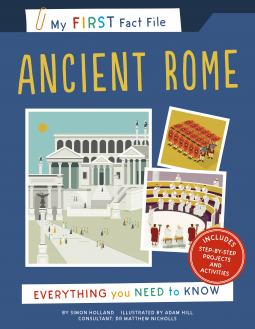
This book is part of a series, My First Fact File.  This is the first one that I have read and all indications are that these entries will be interesting and informative.

Many topics are introduced and described in two page spreads; for each, there are illustrations that enhance the text.  For example, the founding of Rome, the forms of governing, the army, the family and roles of women, entertinments, arts, food,  engineering etc.  are all discussed.  Often there is a “quick fact”  such as this one on public toilets.  Young readers will learn that there were benches that held up to 20 people.  There was no privacy but lots of time to gossip.  There are also suggested projects that will reinforce and enhance learning.  One project is to build a weapon called an onager, others are to design the placement of important buildings in the forum and to elaborate on the kind of emperor the reader would want to be.

I found this book to be easy to read, entertaining and yet also a book that will teach children a lot about an important civilization that still influences us today.  Readers will learn about the Roman Alphabet, calendar and numbers for example that are still in use.

Many thanks to NetGalley and the publisher for this book in exchange for my honest opinion.  I look forward to reading more entries in the series.  This one deserves a place in both school and home

From the publisher:

CHILDHOOD

Children respected their elders and were obedient to the father of the family. The male children of the rich were taught by tutors or in schools, but also had more time to play.

ARTS

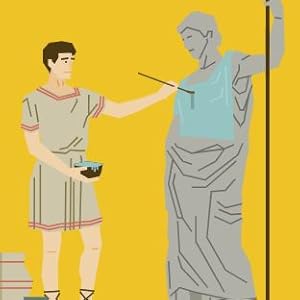
The Romans were brilliant artists.They excelled at mixing the art and architecture of other cultures into their own style and producing high-quality artworks, many of which still survive today.


An eye opener: The Eye of Jade (Wei Liang)

The Eye of Jade: A Mei Wang Mystery (Mei Wang Mysteries) by [Liang, Diane Wei]One of the benefits of taking a class is learning about books that one might not otherwise read.  I had never heard of this novel or author but this is one of the titles for week six of Women Who Sleuth.

I would not say that the mystery itself is the full point of this book.  Rather, it is the portrayal of Beijing.  Readers will feel that they are walking on the crowded streets and going from luxury to poverty with everything in between.  Readers will also be hungry while reading this one; every where there is food; in homes on the streets, in restaurants and it all sounds delicious.

The characters in the novel are noteworthy.  Among them is protagonist Mei who owns and runs a small inquiry agency; it is an inquiry agency because PIs are not allowed.  She has a lot of backstory about her university years and her university love.  Mei has left a government job for reasons that are eventually revealed.  She feels that she is a disappointment to her mother due to her career and single status.  Mei also misses her father, a poet, who died in a labor camp.

Mei’s sister Lu is very different from her.  Money, status and appearance matter to her.  She is a psychologist in the media who married for wealth.  She is also seemingly the favored child.

Mei’s mother has a long history that readers will learn so no spoilers here.  She is in the hospital and very ill which leads to meditations on the nature of life and loss in the novel.  She is a powerful character even when she cannot speak.

Around this, there is a story of missing antiques and a government with corruption.  Characters from Mei’s extended family and her family’s friends also have their roles to play.

I found this book to be fascinating; there is lots of history and culture and characters with whom I enjoyed spending time.  I look forward to reading the next in the series.

From Publishers Weekly

Chinese exile Liang, who fled her country after participating in the Tiananmen Square protests, makes an impressive debut with this understated mystery set in the late 1990s, the first in a prospective series. After resigning from the ministry of public security, Mei Wang launches a private investigative agency, a technically illegal business in China, much to her family’s dismay. After an old family friend, Uncle Chen Jitian, hires Mei to track down a jade seal from the Han dynasty, previously believed to be destroyed, Mei and her assistant, Gupin, follow slim leads to a shady dealer who might have connections to the same museum collection supposedly incinerated by the Red Guard. Readers familiar with Jacqueline Winspear’s Maisie Dobbs will find many parallels between that independent and unconventional PI and Mei. Mei’s challenging family life nicely complements the puzzle of the missing jade and the shifting Chinese political climate. (Feb.)
Copyright © Reed Business Information, a division of Reed Elsevier Inc. All rights reserved.

Excerpt. © Reprinted by permission. All rights reserved.

ONE

In the corner of an office in an old-­fashioned building in Beijing’s Chongyang District, the fan was humming loudly, like an elderly man angry at his own impotence. Mei and Mr. Shao sat across a desk from each other. Both were perspiring heavily. Outside, the sun shone, baking the air into a solid block of heat.

Mr. Shao wiped his forehead with a handkerchief. He had refused to remove his suit jacket. “Money’s not a problem.” He cleared his throat. “But you must get on it right away.”

“I’m working on other cases at the moment.”

“Do you want me to pay extra, is that it? You want a deposit? I can give you one thousand yuan right now.” Mr. Shao reached for his wallet. “They come up with the fakes faster than I can produce the real thing, and they sell them at under half my price. I’ve spent ten years building up my name, ten years of blood and sweat. But I don’t­ want you talking to your old friends at the Ministry, you understand? I want no police in this.”

“You are not doing anything illegal, are you?” Mei wondered why he was so keen to pay her a deposit. That was most unusual, especially for a businessman as shrewd as Mr. Shao.

“Please, Miss Wang. What’s legal and what’s not these days? You know what people say: ‘The Party has strategies, and the people have counterstrategies.'” Mr. Shao stared at Mei with his narrow eyes. “Chinese medicine is like magic. Regulations are for products that don’t­ work. Mine cure. That’s why people buy them.”

He gave a small laugh. It didn’t­ ease the tension. Mei couldn’t­ decide whether he was a clever businessman or a crook.

“I don’t­ like the police — no offense, Miss Wang, I know you used to be one of them. When I started out, I sold herbs on the street. The police were always on my tail, confiscating my goods, taking me into the station as if I were a criminal. Comrade Deng Xiaoping said Ge Ti Hu — that individual traders were contributors to building socialism. But did the police care for what he said? They’re­ muddy eggs. Now things are better. I’ve done well, and people look up to me. But if you ask me, the police haven’t­ changed. When you need protection, they can’t­ help you. I asked them to investigate the counterfeits. Do you know what they told me? They said they don’t­ do that kind of work. But whenever there is a policy change, an inspection, or a crackdown, you can bet they’ll­ jump on me like hungry dogs.”

“Whether you like the police or not, we must play by the book,” Mei said, though she knew her voice was less convincing than her words. Private detectives were banned in China. Mei, like others in the business, had resorted to the counter-­strategy of registering her agency as an information consultancy.

“Of course,” agreed Mr. Shao. A smile as wide as the ocean filled his face.

After Mr. Shao had left, Mei walked over to stand next to the fan. Slowly, the faint breeze flowing through her silk shirt began to cool her. She thought of the time when she was “one of them,” working in the police headquarters — the Ministry of Public Security. Most of their cases were complex or politically sensitive; otherwise, they would not have been sent up by the Ministry’s branches. There were always a lot of agents, bosses, and departments involved. At first Mei liked the excitement and buzz. But as the years went on, she began to feel lost in the web of politics and bureaucracy. It was hard to know what was going on and how to figure out all the pieces of the truth.

Mei moved a little to get the full benefit of the fan. She looked around. Her office was a small room, sparsely furnished and with a window overlooking the dirt yard. Next to it was an entrance hall. Everything inside the agency said low budget and secondhand. Yet she was happy. She liked being her own boss and having full control of the jobs she took on and how she went about them.

The door opened. Mei’s assistant, Gupin, tumbled in, looking like a cooked lobster. Without a word, he dashed over to his desk in the entrance hall and drained a glass jar of tea that had been there since morning. He slipped the army bag from his shoulder and dropped it on the floor. “Was that Mr. Shao, the King of Hair-­Growth Serum, I saw leaving?” He looked up, catching his breath. He spoke with a faint but noticeable accent that gave him away as a country boy.

Mei nodded.

“Are you going to take his case?”

“I told him I would, but now I wonder. There is something odd about that man.”

“He wears a toupee.” Gupin came over with a small packet wrapped in newspaper. “I’ve collected five thousand yuan in cash from Mr. Su.” He smiled. His face, still red from exertion, shone with pride.

Mei took the package and squeezed it gently. It felt firm. She made space for Gupin in front of the fan. “Was he difficult?” she asked. Gupin was now standing next to her, his bare arm almost touching hers. She could smell his sweat.

“At first. But he can’t­ scare me or distract me with his tricks. I’ve seen weasels like him before, and I’ve traveled many roads. I know how to make sure you get your fee, Ms. Mei. People get worried when they see a migrant worker like me in that kind of place.”

The word “weasel” sounded especially nasty in Gupin’s accent. Mei smiled. At times like this, she couldn’t­ help thinking how right she had been to hire him. And how odd it was that she had her younger sister to thank.

When Mei had opened her agency, Lu, her younger sister, was critical of the idea. “What do you know about business? Look at yourself — you don’t­ socialize, you can’t­ cope with politics, you have no Guanxi — none of the networks and contacts you need. How can you possibly succeed? Contrary to what you might think, my dear sister, running a business is tough. I know; I’m married to a successful businessman.”

Mei had rolled her eyes. She was too tired to fight anymore. Since she had resigned from the Ministry of Public Security, everyone seemed to want to lecture her.

“Well, I suppose you are at the end of your rope,” Lu said at last, sighing. “If you can’t­ hold on to your job at the Ministry, what else can you do? You might as well work for yourself. But I can’t­ watch you jump into a churning river without knowing how to swim. Let me find someone who can teach you the basics of business.”

The next day Mr. Hua had called to invite Mei to his office. There, she sat on a dark leather sofa and was served coffee by his pretty secretary while Mr. Hua talked about Guanxi, about which procedures could be avoided and a few that couldn’t­, about creative organization and accounting, and most of all, about the importance of having sharp eyes and ears.

“You need to be sensitive to the change of wind and policy,” he said. “Make sure you always watch out for people who might stab you from behind. And one word of advice” — Mei had quickly learned that “one word of advice” was a favorite expression of Mr. Hua — “don’t­ trust anyone who is not your friend. You want to succeed, then make sure you have a good Guanxi network, especially in high places.” Mr. Hua topped up his coffee for the fifth time. “What about secretaries?” he asked Mei.

“What about them?”

“Have you thought about what kind of secretary you need?”

Mei told him that she had no plans to hire a secretary, not before she had any clients.

Mr. Hua shook his head. “You can hire someone for very little money. There are plenty of migrant workers from the provinces willing to work for almost nothing. The cost of having someone answer the phone or run errands is small, but the benefit is considerable. Your business won’t­ look right without a secretary. If you don’t­ look right, no one will come to you. Look around and tell me what you see.”

Mei looked around. The office was big and full of expensive-­looking furniture. “You’ve got a great place,” she said.

“Exactly. What I have here is what people call a ‘leather-­bag company.’ I invite foreign investors to become part of a joint venture. All foreign firms are required to have a Chinese partner, as you know. They come here to meet me, they see a grand setup, the best address. But they don’t­ realize that I have no factory or workforce of my own. They think I’m important, the real thing. I go and find factories only after I receive money from the foreign firm. If I can do one deal a year, I’m set. Two, I can take the rest of the year off.

“You see, making money is easy. The difficult part is getting people to pay up. That’s why I like to do business with foreigners. It’s much more difficult with the Chinese. One word of advice: When you hire someone, think about payment recovery and make sure your girl is tough enough to do the money chasing.”

Seeing the sense in what he was saying, Mei advertised for a secretary. Among all the applicants, Gupin was the only man. Mei had not considered hiring a man to be her secretary. But she decided to interview him.

Gupin had come from a farming village in Henan Province and was working on Beijing’s construction sites to get by. “I finished at the top of my class at our county high school,” he told Mei. “But I had to go back to my village because that’s where my official record was. I wanted to work in the county town, but my village head didn’t­ agree. He said our village needed a ‘reading book man.'”

It took Mei some time to get used to his accent and understand what he was saying.

“My ma wanted me to get married. But I didn’t­ want to. I don’t­ want to end up like my brother. Every day he gets up at dawn and works in the field all day. By the end of the year, he still can’t­ afford to feed his wife and son. My da was like that, too. He died long ago from TB. Everyone says there is gold in the big cities. So I thought I’d come to Beijing. Who knows what I can do here?”

Mei watched him. He was young, just twenty-­one, with broad shoulders. Packs of muscle were visible under his shirt. When he smiled, he seemed bashful but honest.

Regretfully, she told him that he couldn’t­ do the work she needed. He didn’t­ know Beijing, and his Henan accent would put people off. “They will assume many thin…
  Return to Product Overview

Diane Wei Liang was born in Beijing. She spent part of her childhood with her parents in a labor camp in a remote region of China. In 1989 she took part in the Student Democracy Movement and protested in Tiananmen Square. Diane is a graduate of Peking University. She has a Ph.D. in business administration from Carnegie Mellon University and was a professor of business in the U.S. and the U.K. for more than ten years. She now writes full-time and lives in London with her husband and their two children.

A couple of e book bargains for July 13, 2019

First Impressions


I truly enjoyed First Impressions by Charlie Lovett.  It is a take on Jane Austen’s Pride and Prejudice.  Paris by the Book has been on my TBR pile for a while.  I hope to read it soon.

On First Impressions:

“Part mystery, part love story, First Impressions is a 100 percent thumping good read and a loving homage to one of literature’s most beloved authors. Lovett takes readers on a rollicking adventure that cleverly weaves in the best elements of Austen’s novels, while also giving life to Austen’s own personal history in a satisfying and captivating way. It’s a giddy novel that celebrates books and the people who love them as much as it entertains, making it the perfect read for bookworms and Janeites alike.”
Bookpage

“A completely captivating and charming book….the author’s passion for Jane Austen and his knowledge of printing methods and practices of the 1700s truly make this book a standout. The reader gets a nice adventure story, a little bit of romance and mystery, and a real feel for book collecting and for the author’s love of Jane Austen. If it’s a love you share, you may well find this book irresistible.”
Mystery Scene

Paris by the BookOn Paris by the Book:

“Sublime . . . Callanan has crafted a beautifully drawn portrait of a woman interrupted, set among the exquisite magic of Paris, where life frequently imitates art as the ghosts of the past linger just out of sight.”
Publisher’s Weekly (starred review)

“Callanan has woven a tale of grief, resentment, and the everyday madness of equivocating the unfathomable. . . . Callanan’s sweet and compulsively readable tale invites readers to fall in love with Paris, Leah, and her family.”
Booklist

“A love letter to reading, writing, and all things French, Paris by the Book combines a charming first-person protagonist, a nuanced family drama, and the magic of Paris.”
ShelfAwareness (starred review)

Meet the Girls Like Us (Alger)

I very much enjoyed Cristina Alger’s last book. The Banker’s Wife was suspenseful, fast read with both good characters and good settings. So, I was very excited to be given a copy of the author’s newest novel in exchange for my honest review. Thanks NetGalley and e publisher.

Girls Like Us does its author proud. It, too, is an exciting, fast paced story with a great setting. This time, the locations are all in Suffolk County, New York. Towns in that county like Southampton are populated by many fabulously wealthy and (self) important folk, especially during the summer. Nearby, in towns like Hampton Bays and Riverhead, the locales are not as gentrified and are where many of those who care for the summer dwellers reside. Ms. Alger clearly knows her geography and presents both places with accuracy.

Nell, the protagonist of this novel, works for the FBI. She was injured on her last case and has come to New York following her father’s death. She and he lived in Hampton Bays, on the grittier, more realistic end of Suffolk County. Nell’s father was a Suffolk County cop. Was his death in a motorcycle crash an accident or murder? Did he kill his wife when Nell was just a young child? What was happening at the parties of the wealthy Mr. Meachem? Why were young Latinas being murdered? Who is covering up what and for whom? Who are the guilty parties? There are questions and questions that are answered over the course of this excellent summer read.

Pick up Girls Like Us if you enjoy suspense stories. Like me, I hope that you will enjoy spending time with Nell and in her world.

One of:
Bustle’s “Perfect Vacation Read[s]” and a Beach Read Pick
PopSugar‘s “Best Books of July” and “Best New Books to Put in Your Beach Bag This Summer”
New York Post‘s “20 Beach Reads Sure to Send Chills Down Your Spine”
PureWow
‘s “Best Beach Reads of Summer 2019” 

Crime Reads‘s “Most Anticipated Crime Books of Summer”
Read It Forward‘s “Summer 2019 Thriller” Picks

“Gripping…Brisk…Nell’s work on the case is smart and efficient, which gives the book a crisp tone and pace. Her final discoveries startle her and the reader…Readers will hope to savor more of her gimlet-eyed takes.”—Newsday

“[An] excellent crime novel…[Alger] captures the social dynamics of Suffolk’s eastern extremes perfectly. The first-person narrative is appropriately terse—Nell delivers a thorough report—but it occasionally surprises with a gripping depth….Highly recommended.”—Booklist (starred review)

“[A] propulsive thriller…Alger expertly ratchets up the suspense all the way to the explosive finale. Readers will hope to see more of tough, smart Nell.”—Publishers Weekly 

“[Nell] has a vulnerable, empathetic core that will pull readers in, and Alger has a feel for small-town dynamics….The tension becomes nearly unbearable as Nell realizes she truly can’t trust anyone. Readers can expect a few genuine surprises, and the light Alger shines on society’s most vulnerable members is an important one. Melancholy and addictive.” Kirkus Reviews

“This fast-paced psychological thriller…will intrigue mystery readers as they shadow Nell’s precarious quest for the truth at all costs, despite the consequences.” Library Journal 


My earlier review of The Banker’s Wife:

The Banker’s Wife is a great summer read, especially for those who enjoy novels like The Expats by Chris Pavone. The set up…Annabel is married to Matthew. Matthew is a banker at a Swiss bank that keeps secrets for its depositors. Marina is a journalist who is engaged to a prospective presidential candidate’s son. She works with Duncan. They are trying to locate a notorious Ponzi schemer. The story, of course, is even bigger than this.

Matthew is reported killed in a plane crash along with a cousin of Syria’s dictator. Annabel is left bereaved and unsafe. Marina is unsafe as well. While the two do not meet, they are both impacted by the business practices of Swiss United Bank.

Both Annabel and Marina are connected to a myriad of other characters. There are questions about whom to trust and how to unravel the bank’s schemes and hold those who are guilty accountable. The reader experiences doubts too regarding what has happened and who all of the ‘bad guys’ are.

Christina Alger has written a book that is suspenseful and engaging. The plot is complex but not too hard to follow. The reader will understand more about financial shenanigans and the private banking worlds that are fascinating and not part of many readers’ daily lives.

I truly enjoyed the settings, characters and the plot of the novel. I highly recommend it!

“First-rate…Slick, heart-hammering entertainment.”–The New York Times Book Review

Women Who Sleuth Week 5: Muller and Paretsky

This week we continued with private eye novels, talking about the first V. I. Warshawski novel, Indemnity Only and a later Sharon McCone mystery, The Broken Promise Land.  There was discussion about how these books fit into the women’s movement, the risks that the detectives take, the role of their relationships and decisions not to have children.  The question was raised as to whether they are meant to be based on the characters of the male loner detectives of Marlowe and Hammet.

I have read all of Marcia Muller’s Sharon McCone mysteries and was happy to re visit this title that is set in the world of country music.  The case involves threats that are made to country star, Ricky Savage, who is married to one of Sharon’s sisters.  Long term readers of the series will enjoy the family updates while, readers new to the series, can still enjoy the book.  Of note though, Sharon has various relationships before hers with Hy; these are told in earlier books.

The V. I. books are classics in their field.  They are written by a very well educated author who loves Chicago and makes the place almost another character in the series.  This book showcases V. I.’s first case.  I found that I enjoyed the Muller book more.  If  you read both, let me know what you think.

The Broken Promise Land (A Sharon McCone Mystery Book 17) by [Muller, Marcia]

From Publishers Weekly

Muller surpasses herself with this vigorous and trenchant mystery thriller, exploring stardom and family life, ambition and revenge, loneliness and conflicting loyalties. In her 17th appearance (after A Wild and Lonely Place and Wolf in the Shadows), the continuously evolving San Francisco PI Sharon McCone, now the head of her own small firm, learns from her brother-in-law, country music megastar Ricky Savage, of increasingly incoherent anonymous notes being sent to his unlisted address, all asking the same question: “Whatever happened to my song?” Agreeing to investigate, Sharon is propelled into both the twisted, oversized world of celebrity and the more intimate devastation occurring within her sister Charlene’s family. At the Savage mansion in San Diego hills, Sharon and her lover, security specialist Hy Ripinsky, find the family in turmoil, with Ricky and Charlene, who has found someone new, on the verge of divorce. As the threats escalate to include the six Savage children, safeguards are breached and Ricky’s manager is injured in a shooting. With Ricky’s major tour approaching, Sharon links the notes to an aspiring singer with whom Ricky had a one-night stand in Texas years before, a woman who pursued him so relentlessly he sent two of his band members, now deceased, to rough her up. While Sharon’s associate and friend Rae Kelleher is increasingly involved in tracking down the Texas singer-and with Ricky-Sharon wonders if she and Hy might also be drifting apart. Leading Sharon into the rocky psychological terrain of families, Muller gives her meticulously plotted story, with its absorbing picture of the music industry, a commanding emotional authenticity. Mystery Guild selection.
Copyright 1996 Reed Business Information, Inc.
Indemnity Only: A V. I. Warshawski Novel (30th Anniversary Edition) (V.I. Warshawski Novels Book 1) by [Paretsky, Sara]From a bookseller page:
Meeting an anonymous client late on a sizzling summer night is asking for trouble. But trouble is Chicago private eye V. I. Warshawski’s specialty. Her client says he’s the prominent banker John Thayer. Turns out he’s not. He says his son’s girlfriend, Anita Hill, is missing. Turns out that’s not her real name.

V. I.’s search turns up someone soon enough—the real John Thayer’s son, and he’s dead. Who’s V. I.’s client? Why has she been set up and sent out on a wild-goose chase? By the time she’s got it figured, things are hotter—and deadlier—than Chicago in July. V. I.’s in a desperate race against time. At stake: a young woman’s life.

To make the youngest Anne fans. My First L.M. Montgomery #LucyMaudMontgomery #NetGalley

T

The Little People, Big Dreams series makes books for even littler people! This one is part of the My First…series. It simply tells the story of the author of the Anne of Green Gables books. Children will learn about Lucy, who was raised by her grandparents. She had imagination and found a way to write her beloved classic novels.

This book provides an easy introduction to the author. It is nicely and engagingly illustrated. I, myself, want to collect all these books!

Thanks to NetGalley and Quarto for this book in exchange for an honest review.

Encouraging autonomy for preschoolers: Caillou-I Can Do It Myself (L’Heureux and Kary) #CaillouICanDoItMyself #NetGalley

This brightly illustrated book delivers an empowering message to young children: yes, they can do and try to do many things for themselves.  Caillou wants to dress and undress himself, carry dishes to the table and help clear and more.  Sometimes it is easy, sometimes less so.  Caillou’s dad is patient and encouraging to him.  Caillou then is able to take chances.  This is briefly contrasted with a child whose mom does for her what she wants to do.  It is clear which is the preferred path for parents and children.

Thanks to NetGalley and the publisher for this book in exchange for an honest review.  It is one that deserves a place on young children’s home or nursery school shelves.

Loss for little ones: Mama Bird Loses an Egg (Fournier and Chloloula) #MamaBirdLostAnEgg #NetGalley

The illustrations in this short book are beautiful and full of the wonder of nature.  They form the background to a story that is about a mother bird who loses an egg.  Clearly, this is an anthropomorphized story about miscarriage.  The listener sees how the mama bird’s living child tries to cheer her up as the two go on a flight that shows the beauty of their world.  When they return home, Mama Bird feels better.

This book fills a niche as there are few stories that explain miscarriage to young children. For this reason, it is a valuable resource. The book is sweet but may leave young ones feeling not only that they make their parents happy but also feeling that it is up to them to make things better.  Parents should reassure children that this is not their responsibility but that family love does make things better. This book can open up a tough subject for young children and their parents.

Thanks to NetGalley and the publisher for this book in exchange for an honest review.